Sales Hotline : +65 6749 1911
Services Hotline : +65 8298 5030
Sales Hotline : +65 6749 1911
Services Hotline : +65 8298 5030
Every shop owner understands the challenge of keeping prices accurate and up to date. An incorrect shelf price can confuse customers and undermine their trust. For decades, paper price tags have been the standard solution in retail stores. They are simple, familiar, and easy for most people to understand. However, the retail industry is evolving rapidly. New technology now provides an alternative way to display prices on shelves. This shift is changing both store operations and the way shoppers experience their visits. Choosing between traditional and modern pricing methods can have a greater impact than many retailers realise. Let us explore the key differences between these two approaches. Paper price tags have a long history in retail.
Digital labels are appearing in more stores every day. These compact screens replace the printed cards that retailers have relied on for years. They connect to a central system, allowing prices to be updated seamlessly. As the technology continues to improve and become more affordable, store owners now have a genuine choice for their businesses. Each option comes with its own advantages and disadvantages. Understanding these differences can help retailers select the solution that best suits their needs. This article examines the key considerations without favouring either approach, giving you the information needed to make an informed decision.
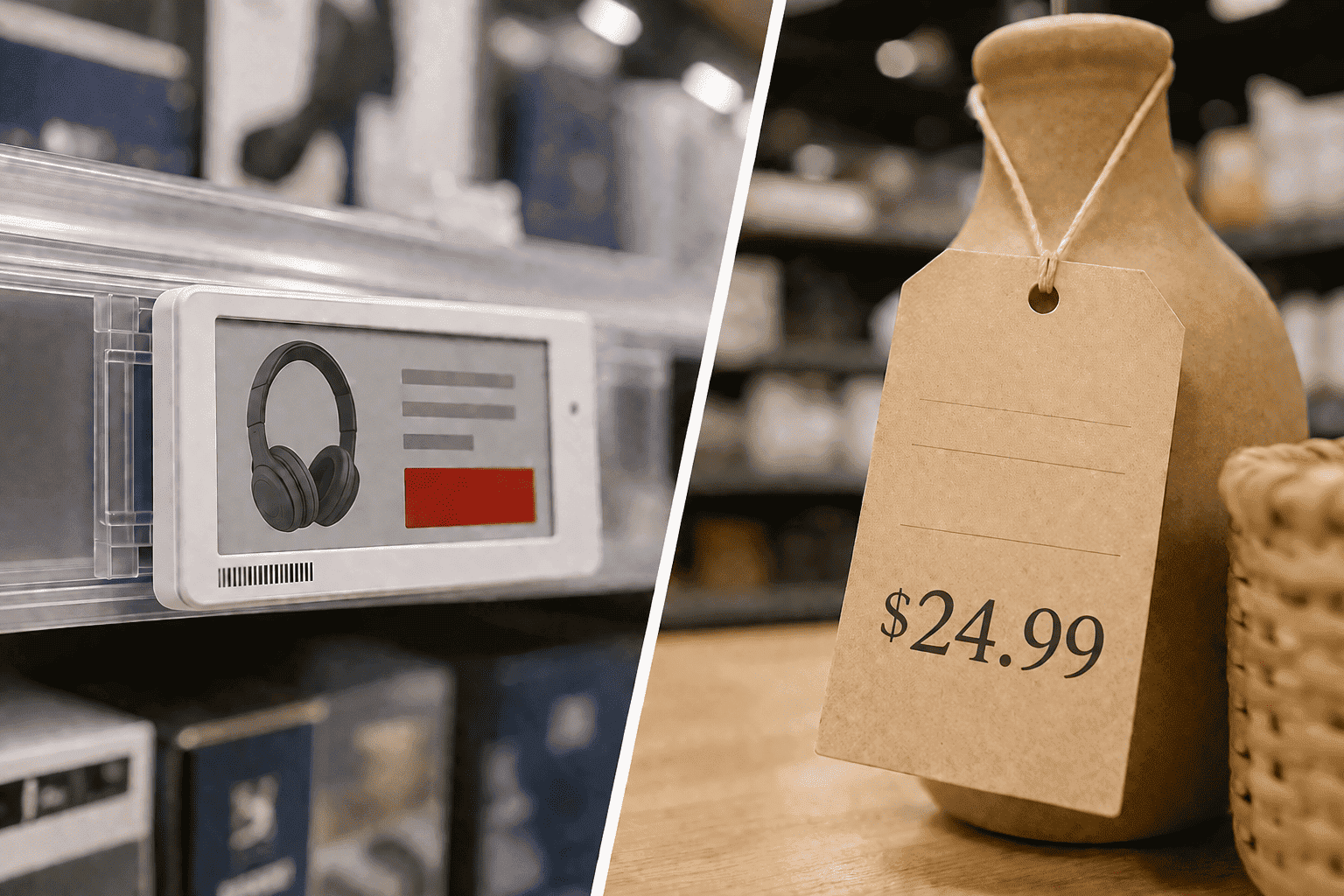
Paper tags have served retailers effectively for many decades. They are straightforward to produce and place on shelves. Staff simply print the tags and position them manually beside the relevant products. This system works particularly well for smaller stores with fewer products and less frequent price changes. It is familiar to both employees and customers, which gives many retailers confidence in continuing to use it. The simplicity of this approach remains appealing to many shop owners.
Getting started with paper tags requires very little upfront investment. A printer and some card stock are usually all that is required. Staff can learn the process within minutes, making it an attractive option for new businesses. There is no complicated setup or specialist training involved. Almost anyone can manage the system without external assistance. It is a simple, self-contained solution that operates independently.
Changing prices with paper tags can require considerable staff time. Every affected product needs a new label to be printed and placed manually. This process must be repeated whenever a price changes. Large stores with thousands of products can find this especially time-consuming. Staff may spend hours walking through the aisles replacing tags, reducing the time they have available to assist customers on the shop floor.
Mistakes can occur when staff perform repetitive tasks manually. A tag may be placed on the wrong shelf, positioned beside the wrong product, or overlooked altogether. This can create discrepancies between shelf prices and checkout systems. Customers may become frustrated when the price they see on the shelf differs from the amount charged at the till. Repeated errors can damage a store's reputation and make it harder to build customer trust.
Digital labels bring greater convenience to the retail environment. These electronic shelf labels display prices on compact screens rather than paper. They connect wirelessly to a store's central pricing system, allowing changes made within the system to appear on the shelves quickly. This removes many of the traditional challenges associated with manual price management. The ESL system makes updates faster and more straightforward, transforming how retailers manage pricing across their stores.
Digital labels can update prices within seconds from a central location. Managers simply enter a new price, and the relevant screens can update simultaneously. This can apply to a single product or multiple products across the store. There is no need for staff to walk around carrying stacks of replacement labels. As a result, employees can save hours of work each week while gaining greater flexibility when implementing pricing strategies.
Automatic updates can significantly reduce pricing errors with digital labels. The system synchronises each screen with the store's pricing database, helping keep shelf and checkout prices aligned. Customers receive more consistent pricing information throughout their shopping experience. There is also less risk of an outdated label being accidentally left behind. Greater accuracy can strengthen customer confidence and contribute to a more reliable shopping experience.
Employees no longer need to spend hours replacing paper labels manually. This frees them to concentrate on other important responsibilities, such as restocking shelves and assisting customers. Staff can spend more time on meaningful interactions that improve the shopping experience rather than repetitive administrative tasks. Digital price tags therefore provide operational benefits while allowing employees to focus on activities that directly support customers and store performance.
| Factor | Paper Price Tags | Electronic Shelf Labels |
| Upfront Cost | Low initial investment | Higher initial investment |
| Ongoing Expenses | Constant paper and ink purchases | Minimal consumable costs |
| Staff Time | High labour for manual changes | Very little labour required |
| Waste Created | Paper discarded after each update | No paper waste from price updates |
| Long-term Value | Costs remain consistent over time | Savings increase over time |
Cost remains an important consideration in any business decision. Both systems have different cost structures that require careful evaluation. Paper tags may appear more affordable initially than digital alternatives. However, considering the total cost over the long term can provide a different perspective. Reduced labour and consumable expenses may make digital solutions more cost-effective over time, particularly for larger retailers with frequent price changes. Environmental impact also differs between the two approaches. Here is a clear comparison of these important considerations.
Some store owners may hesitate to switch to digital labels. They may worry that the technology will be too complicated to operate or question whether the screens will remain reliable over time. These are reasonable concerns that deserve clear and balanced answers. Let us examine some of the most common questions. Digital retail price tags can address many of the challenges traditionally associated with paper labels.
These points address several common concerns raised by shop owners. The technology is now used across a wide range of retail environments, while manufacturers continue to improve durability and ease of use. Many users find the system simpler to manage than they initially expected. For retailers with frequent price changes, the operational benefits can make the transition worthwhile.
Choosing between these two systems requires careful consideration of your store's needs. Start by reviewing your current pricing process honestly. Consider how many price changes occur each week and estimate how much staff time is spent manually updating labels. You should also consider your store's expected growth and operational requirements over the coming years. These factors can help guide your final decision.
Take time to evaluate each option against your specific business requirements. Speak with the employees who will use the system regularly, as their feedback may reveal practical considerations that could otherwise be overlooked. Assess both short-term costs and potential long-term savings carefully. The best solution is ultimately the one that aligns with your store's priorities, resources, and operational needs. Every retail business has different requirements, so there is no single option that works for everyone.
Most price updates take place when stores are closed. Around 92% of changes occur between 2 and 5 in the morning. Daytime updates are generally used for markdowns on fresh products approaching their expiry dates.
Electronic shelf labels do not collect personal data. They simply display pricing information and do not include cameras or customer tracking features. The system operates on a secure, closed network without requiring direct interaction with customers.
Some users report that screens may crack if they are struck by shopping trolleys. Protective rails or clips can help reduce this risk. Manufacturers continue to improve durability with each new generation of products.
Digital labels retain the last displayed price during power outages or connection losses. They do not go blank or lose their stored information because the screens can preserve their displayed content without requiring a constant power supply.